Four hours and fifty-four minutes. That is the number that defines the US Open Murray story, and it belongs to a Monday night in September 2012, when Arthur Ashe Stadium watched a British man win a Grand Slam singles title for the first time since Fred Perry in 1936. The final against Novak Djokovic opened with a first-set tiebreak that Murray took 12-10。the kind of scrap that used to end badly for him. He led two sets to love, lost the third and fourth as Djokovic found his rhythm, then broke early in the fifth and closed it out 7-6, 7-5, 2-6, 3-6, 6-2. Djokovic netted a backhand on match point. Murray dropped his racket and looked up at his box, unsure for a second what to do with his face.Four years earlier, the same court had handed him a lesson. In 2008 he reached his first major final at the US Open at 21。having beaten Rafael Nadal in the semifinals, and then ran into Roger Federer in one of those moods that makes a scoreline look like a formality: 6-2, 7-5, 6-2. That match said more about the gap he had to close than any of his wins. He got there by defending, by absorbing, by waiting for errors, and Federer simply refused to make them. The US Open Murray of 2008 was a counterpuncher with a shaky first serve and a habit of drifting behind the baseline when the points got big. Three years later he lost a semifinal to Nadal in four sets, and the questions about whether he could actually finish one of these things stopped sounding like criticism and started sounding like diagnosis.Then came the long middle. A second Wimbledon title in 2016, a quarterfinal exit in New York that same year against Kei Nishikori, and then the hip. By 2019 Murray had a metal joint where his right hip used to be, and the idea of him playing best-of-five tennis at Flushing Meadows again seemed faintly ridiculous. He did it anyway. He returned in 2020 and lost to Felix Auger-Aliassime. He pushed Matteo Berrettini to four sets in a raucous night session in 2022. In 2023 he beat Corentin Moutet in the first round before Grigor Dimitrov picked him apart. None of those runs ended anywhere near a trophy. What they did was turn the US Open Murray experience into something closer to theatre: the crowd pulling for a man whose body had clearly had enough。
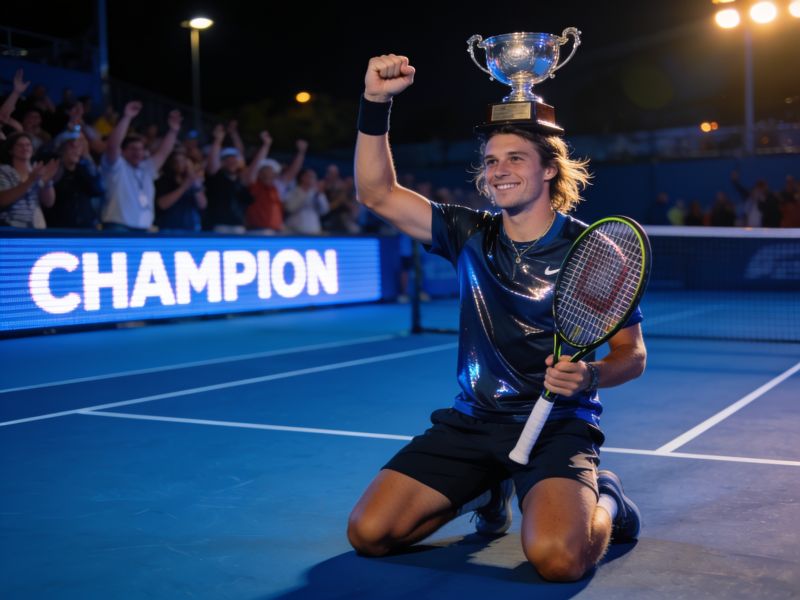
and him refusing to say so out loud.He retired in 2024, at the Olympics in Paris, in a doubles match alongside Dan Evans. Not at Flushing Meadows. Not with a ceremony, not with the sort of send-off the US Open reserves for its favourites. That absence is the strangest entry in the US Open Murray ledger: the tournament where he became a major champion never got to say goodbye properly. Anyone who watched those last few visits will remember the small things instead. The muttering. The fist pumps toward his box. The way he would limp between points and then sprint for a drop shot。as if the legs were a separate business entirely.His legacy in New York is not really the trophy. Plenty of players win one of those. It is how he won it。
with a return of serve that belonged to a different era, with a tactical brain that treated each point like a chess problem, and with a willingness to say out loud in press conferences what everyone else in the locker room was thinking. He was never the most gifted of his generation. He knew that better than anyone, and he built a career out of the knowledge. The 2012 US Open Murray final is the evidence: a man who had lost four major finals before that one, who had spent years being told he was nearly good enough, and who finally stopped being nearly anything at all.